As data-focused computing and AI technologies become widely used, there’s a growing need for storage devices that can hold more data while using less power.
However, the popular NAND flash memory has a disadvantage. It uses a lot of electricity because of limits in how it is designed. In this context, researchers at Samsung Electronics announced a new memory technology using ferroelectric transistors, or FeFET. It can hold more data while using almost no electricity. The study was published on the 27th of the month in the international journal Nature.
NAND Flash Uses A “Array” Structure!
NAND flash uses a “string” structure. In this structure, many memory cells are connected one after the other in a line.
The problem with this structure is that to read the data from one cell, electricity must also be applied to the cells next to it. This extra electricity is known as the “pass voltage.”
This necessary electricity is called “pass voltage.” Because this voltage is required, there is a limit in the structure: the more memory cells there are, the more power is used. However, if the pass voltage is lowered, the signal difference needed to distinguish between memory cells becomes smaller. This makes it much harder to use “multilevel storage,” which means storing several values in one cell.
Researchers Have Developed FeFET Memory Using Ferroelectric Material
To solve these issues, the researchers created FeFET memory, which uses a specific ferroelectric material
A ferroelectric material can be controlled by outside electricity to set its internal direction. Importantly, it holds that state for a long time even after the electricity is removed, and this feature is used to store data.The researchers created a new FeFET by combining two materials: hafnia ferroelectric containing zirconium, and an oxide semiconductor channel.
The new FeFET memory could reliably store up to 5 bits of data per cell. It achieved this even when the pass voltage was reduced to almost zero. Importantly, when compared to traditional NAND, this new technology could save up to 96% of the electricity used in the string structure.This effectively allows the memory to hold significantly more information while using almost no energy. The technology could be used in areas where saving energy is essential, including AI servers, mobile devices, and Edge Computing.
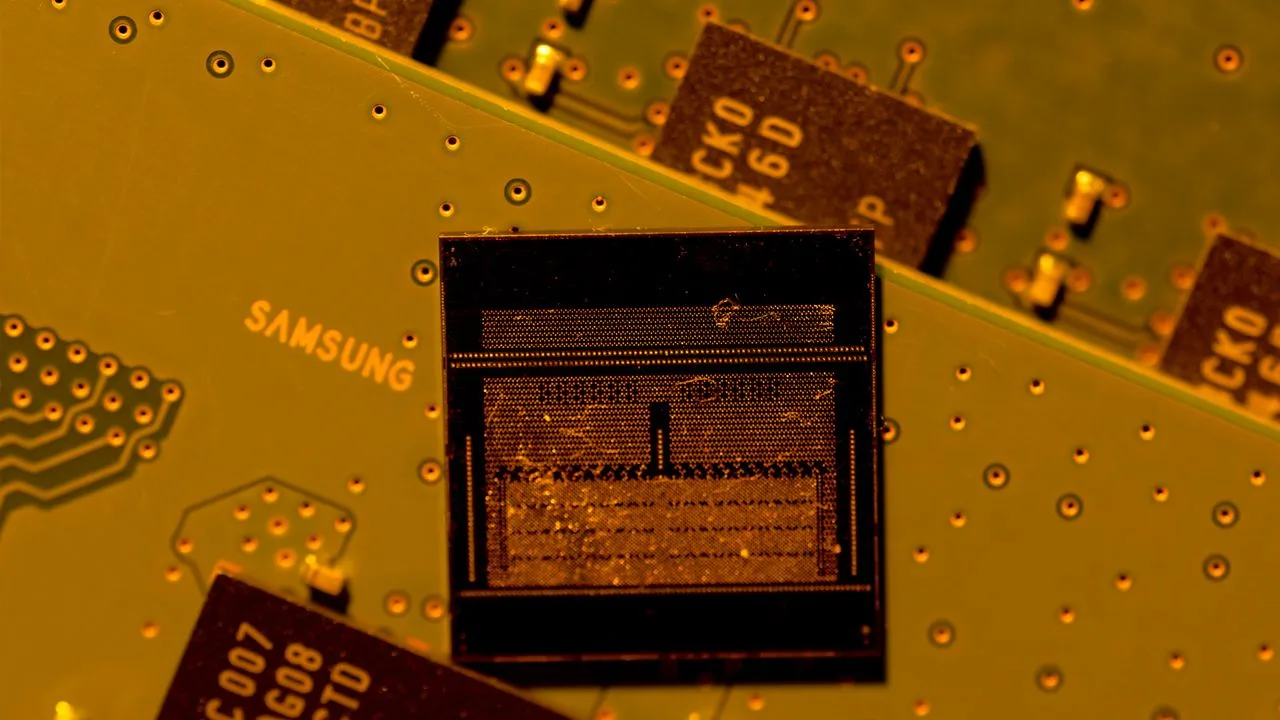
New FeFET’s High Performance Confirmed!
The researchers confirmed that the new FeFET maintains its high performance even when it is built in a three dimensional (3D) structure that stacks vertically, like the design of current NAND. Specifically, it worked reliably even in very tiny cells with a short channel length of 25 nm. Since a nanometer is one billionth of a meter, this confirms there are no problems for making the devices very dense and compact.
This study is important because it solves the main issue of NAND flash. That issue is that “lowering power reduces capacity, and increasing capacity raises power.” The researchers stated that the new FeFET memory is a next generation technology that improves capacity, power efficiency, and reliability simultaneously. They noted it could be used to limit growing energy consumption in areas like neuromorphic and in-memory computing, where NAND architectures are currently important.